Can You See the Cliffs of Moher from the Aran Island Ferry?
Yes, but how good the view is depends entirely on which ferry you take. Here is what you see from a standard Aran ferry, how it compares with a dedicated cliff cruise, and which to book.
 By Niamh O'Connor, Cliffs of Moher & Doolin boat-cruise specialist
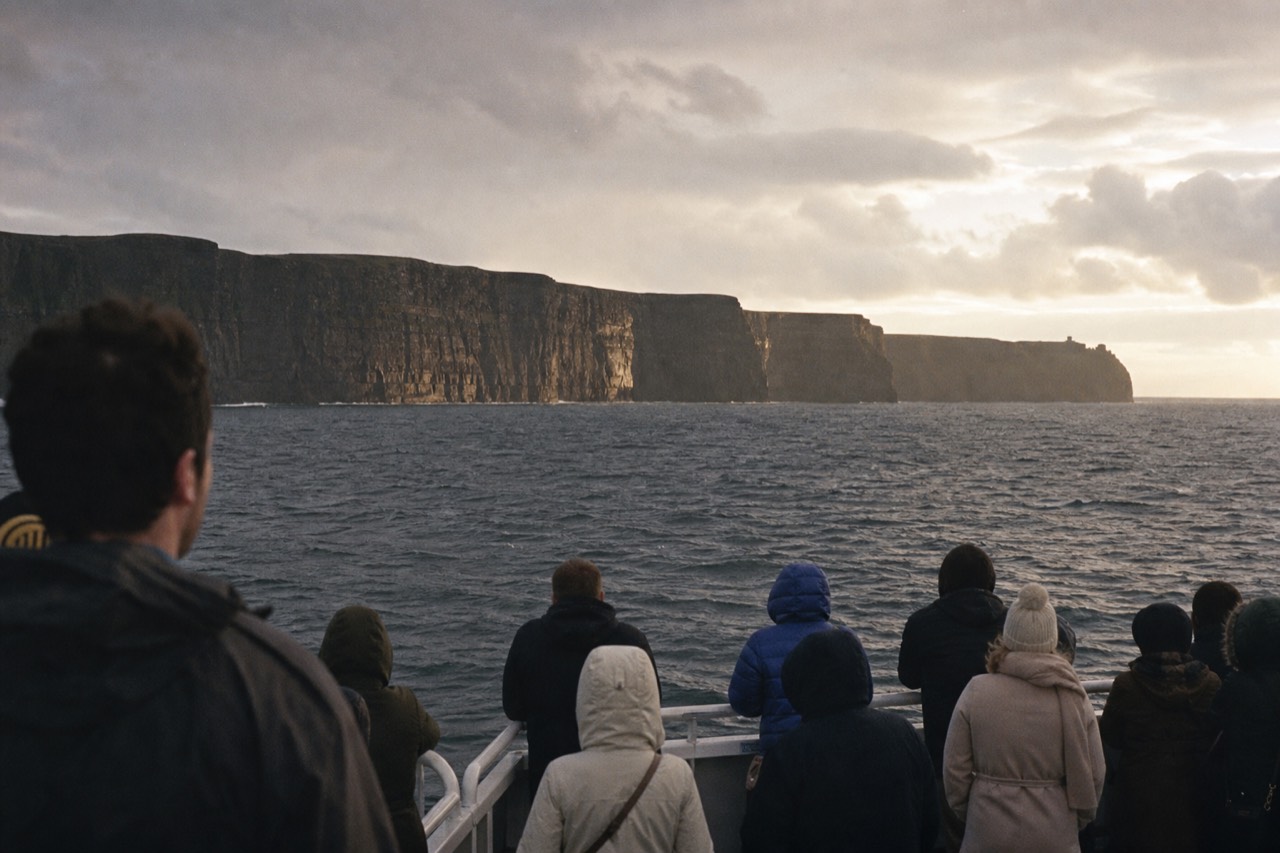
The question sounds simple, and the honest answer has a catch in it. Yes, you can see the Cliffs of Moher from an Aran Islands ferry, but "see" covers everything from a fleeting grey smudge on the horizon to a proper run beneath the cliff wall, and which one you get depends entirely on the ferry you board. Book the wrong one expecting the cliffs to be the star, and you may spend the whole crossing wondering when the good part starts.
Part of the confusion is that several very different boats all get called "the Aran ferry." A ferry out of Galway to the biggest island is a different trip from a Doolin ferry to the nearest island, and both are different again from a dedicated cliff cruise that happens to leave from a ferry pier. The cliffs themselves sit on the mainland Clare coast, not on the islands, so every one of these boats views them from the water rather than delivering you to them. Sorting out which ferry does what is the whole game.
Can you see the Cliffs of Moher from the Aran Island ferry?
Yes, but the quality of the view swings widely. A Galway ferry to Inis Mór only passes the cliffs briefly on the return leg, often well offshore, so you get a distant look of around fifteen minutes. A Doolin ferry runs much closer to the cliffs, and combined tickets add a dedicated cruise beneath them. If the cliffs are the point, choose the ferry that gets you nearest.
The core issue is distance and time. The cliffs are a fixed stretch of mainland coast, and a ferry's job is to reach an island, so any cliff view is incidental to the route unless the trip is built to include one. The Galway boats swing past on their way home; the Doolin boats pass close because the cliffs are right next door to the pier.
That is why two people can both say they "saw the cliffs from the ferry" and mean completely different experiences. One watched a hazy line slide by for a quarter of an hour; the other spent the better part of an hour with the 214-metre wall towering overhead. Knowing which trip you are booking sets your expectations correctly, and our piece on whether the cliffs are on the Aran Islands clears up the geography that makes this so muddled.
Which Aran ferries pass the Cliffs of Moher?
Two routes bring the cliffs into view. Ferries from Galway City to Inis Mór, the largest island, pass the cliffs from a distance on the return leg. Ferries from Doolin to Inis Oírr, the nearest island, run close to the cliffs, and several Doolin tickets add a dedicated cliff cruise on the same boat. The Galway ferry gives the distant view; Doolin gives the close one.
The Galway route is the long one. Boats leave the city docks, sail out across Galway Bay to Inis Mór, and on the way back the cliffs appear on the Clare coast, viewed from a fair way offshore. It is a real sighting, but the cliffs are one moment in a much longer day rather than the main event.
The Doolin route is the close one. Doolin Pier sits at the northern end of the cliffs, so the ferry to Inis Oírr crosses right past them, and the operator's combined tickets let you stay aboard the return sailing for a dedicated cliff cruise. That proximity is why the best sea-level views come from the Doolin side, as our guide to combining the cliffs and Aran by boat sets out in full.
The table lines up what each boat actually gives you at the cliffs, since the word "ferry" hides a wide range of very different views.
| Boat | Base | Island | Cliff time | View from the water |
|---|---|---|---|---|
| Galway Aran ferry and cliffs boat tour | Galway City | Inis Mór | About 15 min on the return leg | Distant, from offshore |
| Doolin ferry to Inis Oírr | Doolin | Inis Oírr | Passes close on the crossing | Close but brief |
| Doolin ferry plus cliff cruise | Doolin | Inis Oírr | 45–60 min dedicated | Beneath the 214 m wall |
| Standalone Doolin cliff cruise | Doolin | None | 45–60 min dedicated | Beneath the 214 m wall |
How good is the view from a standard Aran ferry?
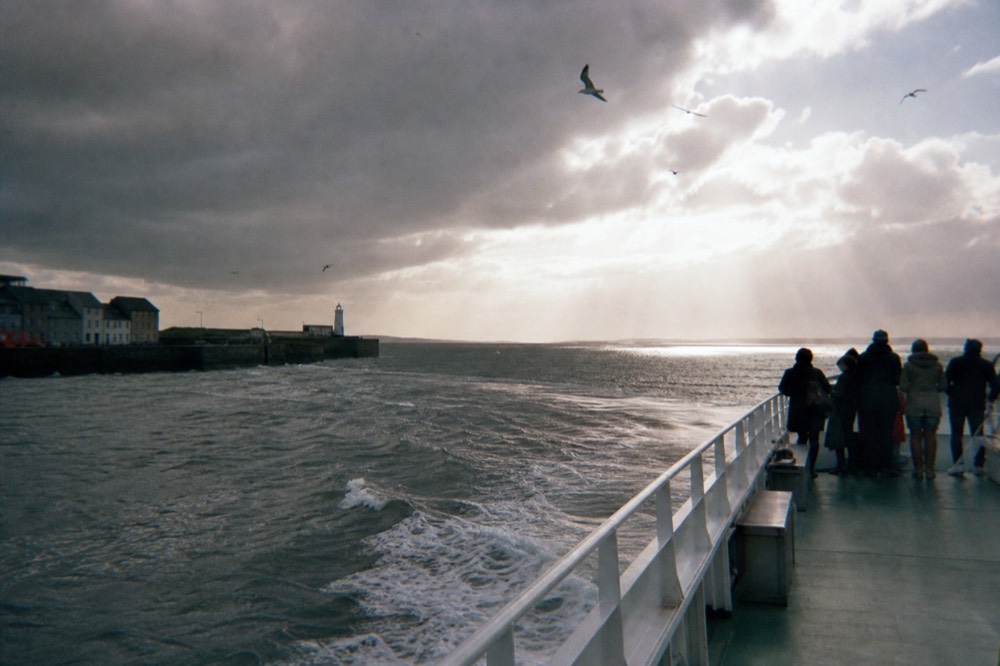
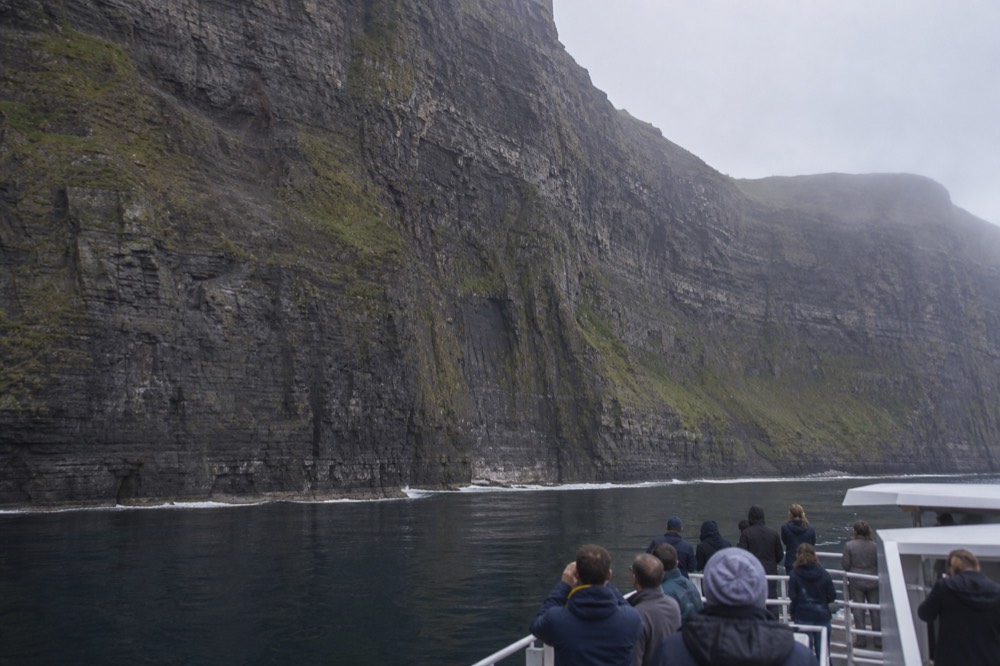
On a standard Galway-to-Inis-Mór ferry, the cliff view is brief and distant: roughly fifteen minutes on the return leg, seen from offshore, with the cliffs as a long dark wall rather than a looming presence overhead. On a clear, calm day it is memorable. In haze or sea fog, which the Clare coast gets often, it can shrink to almost nothing. Manage your expectations accordingly.
The honest picture is that a plain ferry treats the cliffs as scenery, not as a destination. You are on a boat heading somewhere else, the cliffs pass on one side, and the skipper holds course for the harbour. From that distance you take in the length and the setting of the cliffs, but not the height and texture you get from directly below. The seabirds and the sea caves are simply too far away to register.
Weather makes or breaks it. The west coast is prone to mist and low cloud, and August 2026 reviews frequently mentioned fog hiding the cliff tops from the water. On a clear day the distant view is genuinely fine; on a grey one it can be a disappointment, which is worth remembering before you pin your cliff hopes on a ferry pass alone.
There is also the matter of which side of the boat you end up on. On a busy summer ferry the rail facing the cliffs fills quickly, and from an inside seat you may see little of the brief pass at all. Nobody reserves you a cliff-side spot on a plain ferry, because the cliffs are not the point of the crossing. On a dedicated cruise the whole boat is positioned for the view and slowed for it, which is one more reason the two experiences are not really comparable. Our rundown of which ferry gives the best cliff views ranks them from the closest look to the most distant.
Ferry pass versus dedicated cliff cruise: what is the difference?
A dedicated cliff cruise runs 45 minutes to an hour right beneath the wall from Doolin Pier, slowing at the sea stack, the caves and the bird colonies. A standard ferry pass is a distant fifteen-minute glimpse from offshore. The cruise is a purpose-built sightseeing trip; the ferry pass is a bonus view on a journey to an island. For the cliffs themselves, the cruise wins clearly.
The gap is not subtle once you see the numbers. A dedicated cruise gives you three to four times the cliff time, at a fraction of the distance, with commentary pointing out the features. It reaches the base of the 214-metre wall, drifts by the An Branán Mór sea stack and the sea cave used in a Harry Potter film, and lets the seabirds come into view. The official cliffs visitor centre and the operators describe exactly these features, and our guide to what you see on a cliff cruise walks through them point by point.
The commentary is part of the gap too. A dedicated cruise carries live crew commentary, often with audio in several languages, pointing out the sea stack, the caves and the nesting birds as you pass, so you understand what you are looking at. A ferry crossing offers none of that for the cliffs, which slip by unannounced while the boat presses on toward the harbour. Context turns a wall of rock into a story, and only the cruise provides it.
A ferry pass gives you none of that detail, just the outline in passing. That does not make the ferry a bad trip. If your real goal is to spend a day on Aran and catch the cliffs as a scenic extra, the ferry does the job and saves you a separate booking. But if the cliffs are the thing you came to Ireland for, do not rely on a ferry to deliver them. The team behind Cliffs of Moher Cruises keeps that distinction sharp so you book the trip that matches what you actually want to see.
Do you change boats, or does one boat do both?
On the Doolin combined tickets, one boat does both. You take the ferry to Inis Oírr, spend time on the island, then stay aboard the return sailing for the cliff cruise, with no need to change vessels or rebook at the pier. On the Galway ferry, it is a single boat too, but the cliffs are only the distant return-leg view, not a separate cruise.
The Doolin arrangement is the neat one. The operator, the Doolin Ferry Company, describes the ferry-plus-cliff-cruise as its most popular combined ticket precisely because the same boat carries you out, waits while you explore, and runs the cliffs on the way back. You board once and the day flows from island to cliffs without a break. It is the closest thing to a two-in-one boat trip on this coast.
One practical upside of the Doolin combo is timing control. Because you choose your island return sailing, you can line up the cliff cruise leg for the calmer morning hours or a slot that suits the forecast, rather than being locked to a single ferry schedule. That flexibility is part of why the Doolin side consistently delivers the better cliff experience, weather being the one thing that decides any sailing on this coast.
The Galway boats are simpler still in structure but weaker on the cliffs: one vessel, out to Inis Mór and back, with the cliffs as a passing view rather than a dedicated leg. If you want the island and a proper cliff cruise from the same boat, the Doolin combo is the way, and you can check the current price and sailing times for the standalone Doolin cruise if you would rather skip the island entirely.
Is the Galway ferry-and-cruise combo worth it?
For a full day on Inis Mór with the cliffs as a scenic bonus, yes. The Galway Aran ferry and cliffs boat tour is rated 4.6 across 1,932 reviews, runs about 8.5 hours from around €60, and pairs a big island with the cliffs viewed from the sea on the way back. Just book it for the island first and the cliffs second, not the other way round.
The Galway ferry day earns its rating by being a good island trip. Inis Mór is the largest and most dramatic of the Aran Islands, with the Dún Aonghasa cliff fort and miles of stone-walled lanes, and a full day there is genuinely worthwhile. The cliffs on the return are a fine extra on a clear day, and the price undercuts the guided coach tours. You can check the current price and departure times for the ferry day, which sails from the Galway docks.
It helps to picture the day honestly. You spend the bulk of it on Inis Mór, cycling the lanes, walking up to Dún Aonghasa, eating lunch by the harbour, and the cliffs are a fifteen-minute epilogue as the boat heads home. For a lot of people that balance is exactly right, a big island day with a scenic send-off. For anyone whose heart was set on the cliffs at full height, the balance sits upside down, and that mismatch is where the occasional low review comes from.
Where it disappoints is when people expect the cliffs to be the headline. They are not, on this trip. The return pass is brief and distant, so a visitor whose main aim was the towering sea-level wall can come away underwhelmed. If that is you, either add a dedicated cruise or base yourself at Doolin instead. Our look at whether you can take a boat from Galway to the cliffs explains why there is no direct cliff boat from the city.
Ferry or dedicated cruise, which should you book for the cliffs?
Book a dedicated cliff cruise if the cliffs are your priority: 45 minutes to an hour beneath the wall from Doolin, from about €30, is the clearest sea-level view there is. Book the Aran ferry if a day on the islands is the goal and the cliffs are a welcome extra. Choose by what you most want to remember, the cliffs up close or the island underfoot.
The decision really is that clean. If someone asked you afterward what the day was about, and the honest answer is the cliffs, then a dedicated cruise is the trip, whether standalone from Doolin or as the cruise leg of a Doolin combined ticket. If the answer is the island, the Galway ferry is the better value and the cliffs come free with the return crossing.
Plenty of people do both across a trip: a ferry day on Inis Mór for the island, and a separate short cruise from Doolin for the cliffs at full height. If you have the time, that pairing gives you the best of each without asking one boat to do a job it was never built for. For choosing between the sailings themselves, the three Doolin cliff cruises compared and the Galway day trip options cover the specifics.
If your trip has room for only one boat and the cliffs are non-negotiable, do not let the word "ferry" convince you it is close enough. The dedicated cruise exists precisely because a ferry pass leaves the best of the cliffs out of reach. Spend the extra time, or take the short detour to Doolin, and you get the version people describe for years afterward rather than the version they shrug about at dinner.
And if you cannot reach Doolin at all, the honest fallback is to enjoy the Galway ferry for what it is. A distant cliff view on a clear day is still a memory worth having, and a full day on Inis Mór more than fills the rest of the outing. Book it knowing the cliffs are the encore rather than the headline, keep an eye on the forecast for a clear crossing, and you will come home pleased instead of feeling short-changed by a grey smudge on the horizon.
Frequently asked questions
Do you see the Cliffs of Moher on the Aran ferry from Galway?
Yes, but only from a distance on the return leg, for roughly fifteen minutes and often well offshore. The Galway ferry to Inis Mór is an island trip first, with the cliffs as a passing scenic view on the way back. On a clear day it is a fine sighting; in haze or sea fog it can shrink to almost nothing, so manage your expectations.
Is the Aran ferry the same as a Cliffs of Moher cruise?
No. A dedicated cliff cruise runs 45 minutes to an hour right beneath the 214-metre wall from Doolin, slowing at the sea stack, caves and bird colonies. A standard Aran ferry only passes the cliffs briefly from a distance. Some Doolin combined tickets do add a real cliff cruise on the same boat, but a plain ferry crossing is not a cruise.
Which ferry gets closest to the Cliffs of Moher?
The Doolin ferries get closest, because Doolin Pier sits at the northern end of the cliffs and the boats cross right past them to Inis Oírr. Several Doolin tickets also add a dedicated cliff cruise on the return. The Galway ferry to Inis Mór passes the cliffs only from a distance, so for the nearest view, choose a Doolin departure.
Do you have to change boats to do the island and the cliff cruise?
Not on the Doolin combined tickets. You take the ferry to Inis Oírr, explore the island, then stay aboard the return sailing for the cliff cruise, with no vessel change or rebooking at the pier. The operator markets it as its most popular combined ticket for that reason. On the Galway ferry it is one boat too, but the cliffs are only the distant return-leg view.
Should I take the ferry or a dedicated cruise for the cliffs?
Take a dedicated cruise if the cliffs are your priority, since 45 minutes to an hour beneath the wall from Doolin, from about €30, is the clearest sea-level view. Take the Aran ferry if a day on the islands is the main goal and the cliffs are a welcome extra. If you have time, do both: a ferry day for the island, a short Doolin cruise for the cliffs.
How long do you see the cliffs for on the Galway ferry?
On the Galway ferry to Inis Mór, the cliffs come into view for roughly fifteen minutes on the return leg, seen from offshore. It is a passing scenic moment rather than a slow, close encounter. A dedicated cliff cruise from Doolin gives you three to four times as long, right beneath the wall, which is the trip to book if the cliffs are what you most want to see.