What Is the Weather Like at the Cliffs of Moher in May?
What May weather is really like at the Cliffs of Moher, why it suits a cliff cruise, what to pack, the puffin window, and how the month compares with the rest of the season.
 By Niamh O'Connor, Cliffs of Moher & Doolin boat-cruise specialist

May on the west coast of Ireland is a gambler's month with a generous streak. The light stretches long into the evening, the grass on the clifftop is at its greenest, the puffins are back on the ledges, and the summer crowds have not yet arrived in force. What May will not promise is a settled sky. A single morning can hand you flat calm and clear air, then a passing Atlantic shower, then bright sun again, all before lunch.
That changeability is the thing to understand before you plan a cliff cruise around it. The month sits in the sweet spot of the season for wildlife and daylight, but the sea and sky still keep their independence. Knowing what May tends to do, and how to work with it, turns an unpredictable month into one of the best times of year to see the Cliffs of Moher from the water.
What is the weather like at the Cliffs of Moher in May?
May at the Cliffs of Moher is mild, breezy and changeable, with long daylight and a mix of bright spells and passing Atlantic showers. Daytime temperatures usually sit in the low-to-mid teens Celsius, cooler and windier right on the exposed clifftop and out on the water. It is drier and calmer on average than the depths of winter, but no day is guaranteed.
The cliffs face the open Atlantic, so weather arrives fast and leaves fast. A grey, drizzly start can clear to a bright afternoon, and a sunny morning can cloud over as a front moves in off the sea. This is normal for the Clare coast in spring, and it is why a flexible plan beats a fixed one. The exposed clifftop and the water below always feel several degrees cooler and windier than a sheltered street in nearby Doolin.
Rain in May tends to come in showers rather than all-day downpours, blowing through on the wind and clearing almost as fast as it arrived, so a grey ten minutes is rarely the whole morning. What you cannot count on is a full day of unbroken sun, and the wind is a near-constant companion on this coast. Treat any May forecast as a rough guide and dress for a mix, because the day you get may run through several moods before it settles.
The upside of May is real, though. The season is well open by then, the days are long, and the light in the evenings is soft and clear when the sky cooperates. The 2026 sailing season opened on 28 February, so by May the boats have been running for weeks and the operator has the timetable in full swing. For a wider view of how the months stack up, our guide to the best time for a cliffs cruise sets May in context against the rest of the year.
The three Doolin cliff cruises all run through May on shared boats, operated by the Doolin Ferry Company group. May's appeal is that you get the wildlife of early summer and the calmer crowds of the shoulder season at the same time, which is a combination July and August cannot offer. The catch is the weather's unpredictability, and the rest of this guide is about planning around it.
Is May a good month to take the cliff cruise?
Yes, May is one of the best months for the cliff cruise. The puffins are on the cliffs, the light is long, the crowds are thinner than in high summer, and the sea is often workable on calm mornings. The trade-off is a higher chance of a changeable or windy day than in settled summer weather, which is exactly what free cancellation and a flexible date are for.
For a wildlife-minded visitor, May is close to peak. Atlantic puffins arrive at the cliffs from the end of March and stay until mid-July, with the best viewing in May and June, so a May cruise catches them squarely in season. Alongside the puffins you will usually see guillemots, razorbills, kittiwakes and fulmars packed onto the ledges and the An Branan Mor sea stack, one of Ireland's major seabird colonies. The official cliffs site lists the full range of species you might spot.
The crowd picture helps too. May falls in the shoulder season, quieter on the pier and the roads than the July and August peak, so walk-up tickets are easier and the popular morning sailings are less likely to be full. That said, a warm, bright May week can draw summer-sized crowds, so booking a day or two ahead is still the safer habit. To see live availability for a May date, check the current price and sailing times on the listing. Our look at puffins and seabirds on the cruise goes deeper on what you will see and when.
What should you pack for a May sailing?
Pack for three seasons in one trip: a warm layer, a windproof and waterproof outer layer, and something for bright sun. The water and the exposed clifftop are always cooler and windier than town, spray comes over the side in any swell, and the light off the sea is strong. Layers you can add and shed beat a single heavy coat every time.
The single biggest comfort mistake on a May cruise is dressing for the temperature in the car park rather than the temperature on the water. Out at the base of the cliffs the wind is constant and the air is damp, so a fleece or jumper under a waterproof shell is the reliable combination. A hat and gloves are not overkill on a breezy morning, and a spare layer in a bag costs nothing to carry.
| What to bring | Why it matters in May |
|---|---|
| Warm mid-layer | The water is cooler and windier than town |
| Waterproof, windproof jacket | Passing showers and sea spray are likely |
| Non-slip flat shoes | Decks and the pier can be wet |
| Sunglasses and sun cream | Bright light reflects hard off the sea |
| A dry bag or ziplock | Keeps a phone and camera safe from spray |

Treat the list as a planning allowance, not a forecast. Some May days are warm and still enough for shirtsleeves, and you can always shed a layer. The trips people regret are the ones where they arrived underdressed for the wind and spent the hour cold, so err toward carrying one layer too many.
Footwear deserves a moment of thought too. The pier and the boat deck can be wet, and a spring shower makes both slick, so flat shoes with grip beat sandals or smooth soles. If you plan to pair the sailing with a clifftop walk the same day, comfortable walking shoes that can handle a damp path do double duty. None of this needs to be specialist gear, just clothes and shoes chosen for a breezy, damp coast rather than a warm city.
Will the boat still run in May weather?
Usually yes. May sits comfortably inside the 28 February to 1 November sailing season, and the boats run daily in the core months, weather permitting. Sailings are only cancelled when the sea is unsafe or too rough to be enjoyable, and if the operator cancels you get a full refund or a place on another sailing. Calm mornings are the most reliable.
The season length matters here. Because 2026 sailings started on 28 February and run to 1 November, a May trip lands in the settled middle of the operating calendar, not at a fragile edge. On most May days the boats sail their full timetable. When a front brings big wind or swell, the operator makes the call to cancel or amend, and that judgment is about comfort and safety on the Atlantic rather than a fixed wind number.
If your sailing is cancelled, the money is protected. The operator emails affected passengers and offers a full refund or a reschedule, so a booked May ticket is low-risk. To see the exact terms and live times for a May date, check the current price and sailing times on the listing. The newer stabilised boat, the Cliffs of Moher Express delivered in 2025, also rides steadier than the older hulls when a May swell is running.
How long are the daylight hours in May?
May has long, generous daylight on the west coast. By the end of the month the sun is up well before any sailing and does not set until after nine in the evening, giving a wide, bright window over the whole cruise timetable. That long day means every scheduled departure runs in good light and leaves plenty of room to fit a clifftop visit or a coastal drive around your boat trip.
The stretch of daylight is one of May's underrated advantages. Where a short winter afternoon can leave a late sailing feeling dim, a May evening holds its light for hours, so even the last departure of the day runs under a clear sky when the weather cooperates. For photographers, the low, soft light of a May evening on the cliffs is some of the best of the year.
Long days also give you flexibility. If a morning looks rough and an afternoon looks calmer, May's timetable and daylight let you take the later slot without running out of light, something the shoulders of the season at either end cannot always offer. Pairing the cruise with the clifftop becomes easy too, since there is time for both without either feeling rushed.
Is it better to sail in the morning or the afternoon in May?
Morning is usually the better bet in May. The sea tends to be calmer earlier in the day before the wind builds, the light is fresh, and an early slot leaves room to rebook if the afternoon turns. Afternoons can be lovely when the weather holds, but a morning cruise stacks the odds toward a smoother, clearer ride.
The morning advantage is partly about wind and partly about flexibility. Atlantic wind often strengthens through the day, so an early departure catches the calmest water and the best chance of a steady deck. It also gives you a fallback: if a booked morning is cancelled, there may be a later sailing the same day to move to, whereas a cancelled last slot leaves nowhere to go.
May's long daylight widens your options, since sunset comes late enough that even an evening sailing runs in good light. Still, for the balance of calm sea and rebooking room, the earliest slot you can manage is the smart default. Our dedicated look at morning versus afternoon sailings weighs the two in more detail across the season.
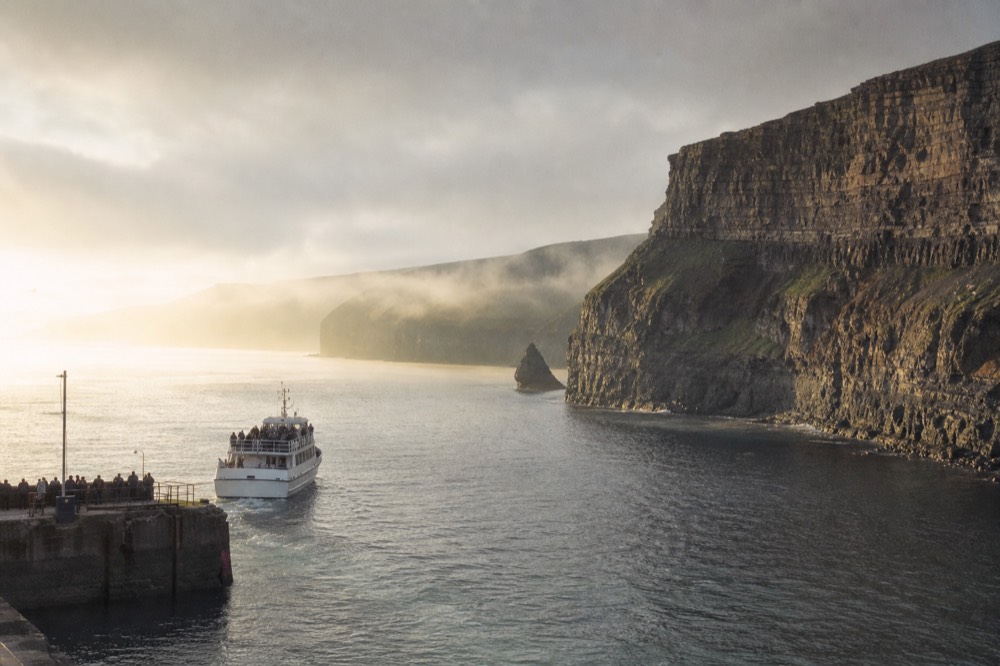
What wildlife will you see in May?
May is prime seabird season. Puffins are on the cliffs and the grassy slopes near the An Branan Mor sea stack, alongside guillemots, razorbills, kittiwakes, fulmars and shags in one of Ireland's biggest seabird colonies. Dolphins, seals and the occasional basking shark are possible from the boat but never guaranteed, so treat any marine sighting as a bonus.
The puffins are the headline. They arrive at the end of March and stay to mid-July, and May sits right in the best viewing window, so a May cruise is one of the surest ways to see them from the water. The crew usually slows the boat near the sea stack, where the birds cluster thickest, and points out the species as you pass. It is a different experience from the clifftop, where the birds are far below you rather than at eye level from the sea.
Marine life is the wild card. Bottlenose and common dolphins, grey seals and, rarely, minke whales or basking sharks are all listed as possible, but the honest framing is that none of them is promised on any given sailing. A calm May morning improves the odds a little, since flat water makes fins and backs easier to spot, but even then a blank day is common and a single dolphin surfacing counts as a lucky trip rather than the expected one. The National Parks and Wildlife Service tracks the protected seabird colonies along this coast. If wildlife is your main reason to go, May and June are the months to pick, and a calm morning gives the boat the best chance to linger near the colony.
There is a real difference between seeing the birds from above and seeing them from the water. On the clifftop, the colonies are far below you, small shapes on distant ledges. From the boat, you draw level with them, close enough to watch a puffin whir past low over the swell or a guillemot drop off a ledge to fish. For anyone who cares about wildlife, that eye-level angle is one of the strongest reasons to take the May cruise rather than only walking the top.
How does May compare with the rest of the season?
May offers the strongest mix of long daylight, active wildlife and manageable crowds, with only the weather's unpredictability against it. It is calmer on the pier than July and August, better for puffins than the September shoulder, and busier and greener than the early-season weeks in March. For many visitors it is the pick of the season, if you plan around the changeable sky.
Set against high summer, May trades a little weather certainty for far fewer crowds and easier walk-up tickets. Set against the autumn shoulder, May wins on wildlife, since the puffins have gone by September. Set against the opening weeks in early spring, May is greener, warmer and busier, with the full timetable running. The one thing every part of the season shares is that the Atlantic decides the day.
| Month or period | Weather feel | Crowds | Wildlife |
|---|---|---|---|
| March to April | Cool, changeable, quieter | Light | Puffins arriving late March |
| May | Mild, breezy, long light | Moderate | Peak puffin season begins |
| June | Mild, often settled | Building | Peak puffins and seabirds |
| July to August | Warmest, busiest | Heavy | Puffins until mid-July |
| September to October | Cooler, more Atlantic swell | Easing | Puffins gone, seabirds thinning |
The honest broker take from Cliffs of Moher Cruises is that May rewards a flexible traveller more than a rigid one. Book an early morning, keep a backup date, pack for wind and rain even under a blue sky, and you get the best of the month: the birds, the light and the quiet. Our guide to the calmest months to sail and the blog on the best month to visit both help you weigh May against the alternatives.
Frequently asked questions
Is May a good time to visit the Cliffs of Moher?
Yes. May brings long daylight, active puffin and seabird colonies, and lighter crowds than high summer, with the sailing season in full swing since 28 February. The main caveat is changeable Atlantic weather, so mornings tend to be calmer and clearer. Book an early slot, pack for wind and showers, and May is one of the best months of the year to sail.
How cold is it on the water at the Cliffs of Moher in May?
Cooler and windier than in town. Daytime air usually sits in the low-to-mid teens Celsius on land, but the exposed water and clifftop always feel several degrees colder, with a steady breeze and possible spray. A warm mid-layer under a waterproof, windproof jacket is the reliable combination. Dressing for the car-park temperature rather than the water is the common comfort mistake.
Will I see puffins on a May cruise?
Very likely. Atlantic puffins are at the cliffs from the end of March until mid-July, and May falls in the best viewing window, so a May sailing is one of the surest times to see them from the water. The crew usually slows near the An Branan Mor sea stack where the birds cluster, alongside guillemots, razorbills, kittiwakes and fulmars in the colony.
Do cruises get cancelled often in May?
Not usually. May sits in the settled middle of the 28 February to 1 November season, and the boats run daily in the core months, weather permitting. Cancellations happen only when the sea is unsafe or too rough to enjoy, and if the operator cancels you get a full refund or a place on another sailing. Calm mornings are the most reliable slots to book.
Should I book a May cruise ahead or just turn up?
May is shoulder season, so walk-up often works on a calm weekday morning, but a warm, bright week can draw summer-sized crowds. Booking a day or two ahead is the safer habit, and the core cruise carries free cancellation on the listing, so an advance ticket costs nothing to hold. An early slot also gives the calmest water and room to rebook if the weather turns.