Puffins and Seabirds on a Cliffs of Moher Cruise: When and What You'll See
Puffins are at the cliffs for a narrow window each year. Here is exactly when, which other seabirds share the ledges, and how to see them from the water.
Short answer
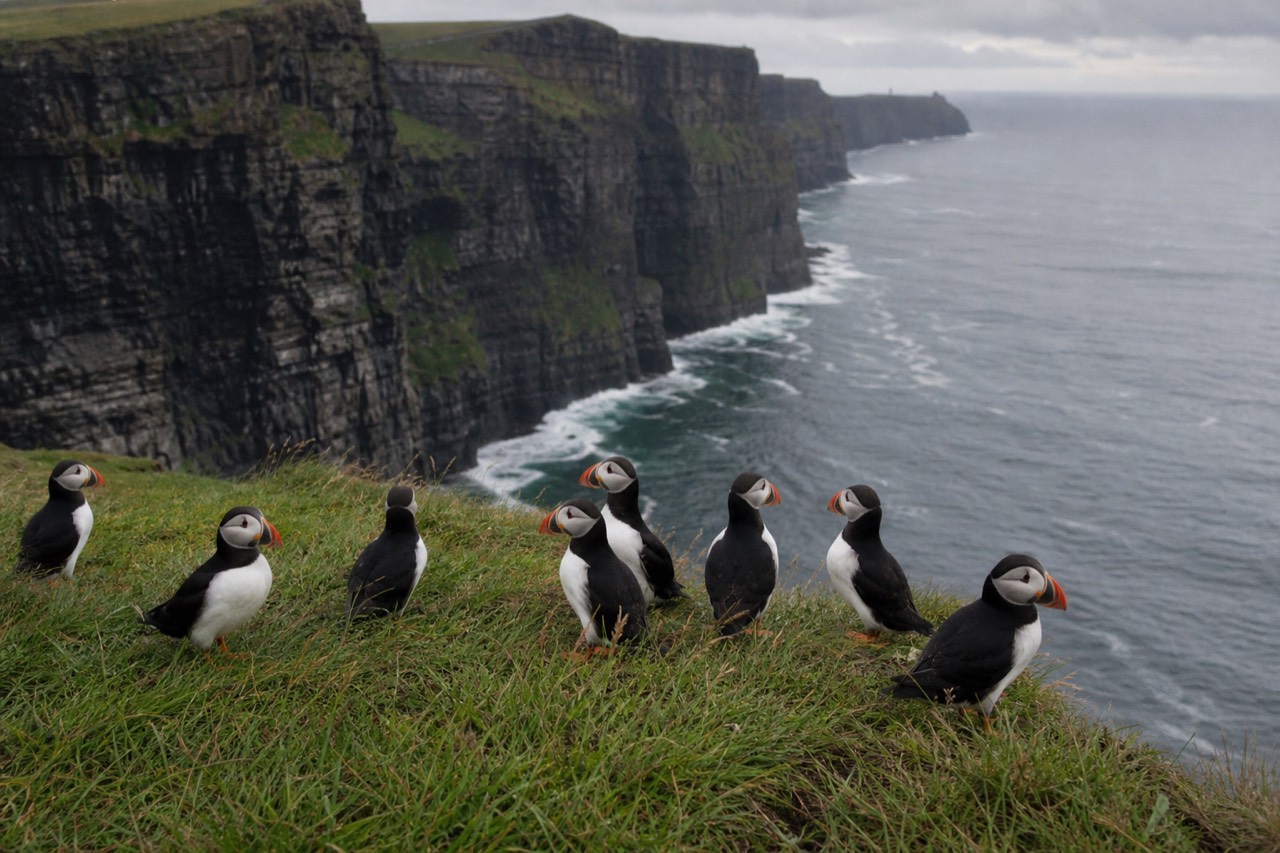
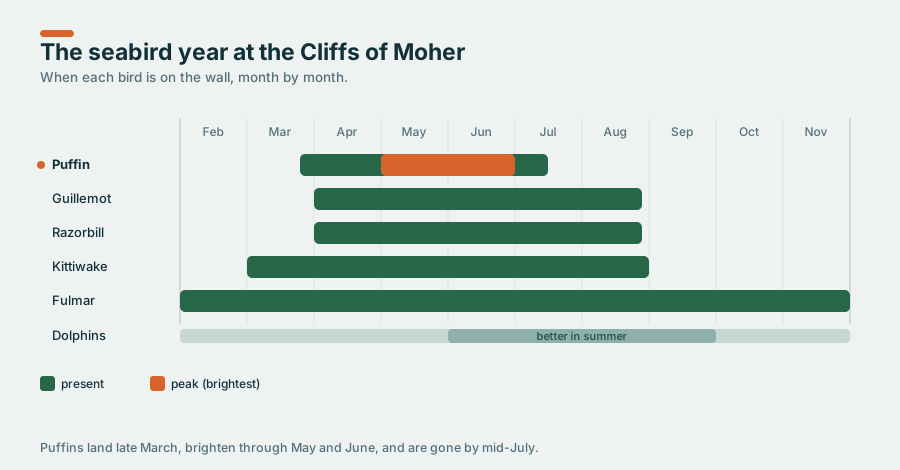
Puffins are at the Cliffs of Moher from the end of March to mid-July, at their best in May and June, nesting on grassy slopes and Goat Island. The rest of the season you will see guillemots, razorbills, kittiwakes, fulmars and shags on the ledges from the boat. Dolphins and seals are possible, never guaranteed.
The puffins do not read the calendar you wish they would. People book a July cruise expecting the little orange-beaked birds on every ledge, and by late July many have already gone back out to sea for the winter, leaving the grassy slopes quiet. Come in October and there are no puffins at all, though the cliffs are still loud with guillemots and fulmars. The seabird year at the Cliffs of Moher has a shape, and if you know it, you can book the sailing that actually lands you in front of the birds you came for.
This guide sets out that shape: when puffins arrive and leave, which species hold the ledges through the rest of the season, where on the cruise the birds concentrate, and what your real odds are of a good sighting on any given trip. It also covers the marine life the operators list, dolphins, seals and the occasional whale, and it is honest that those are possible, not promised.
When can you see puffins on a Cliffs of Moher cruise?
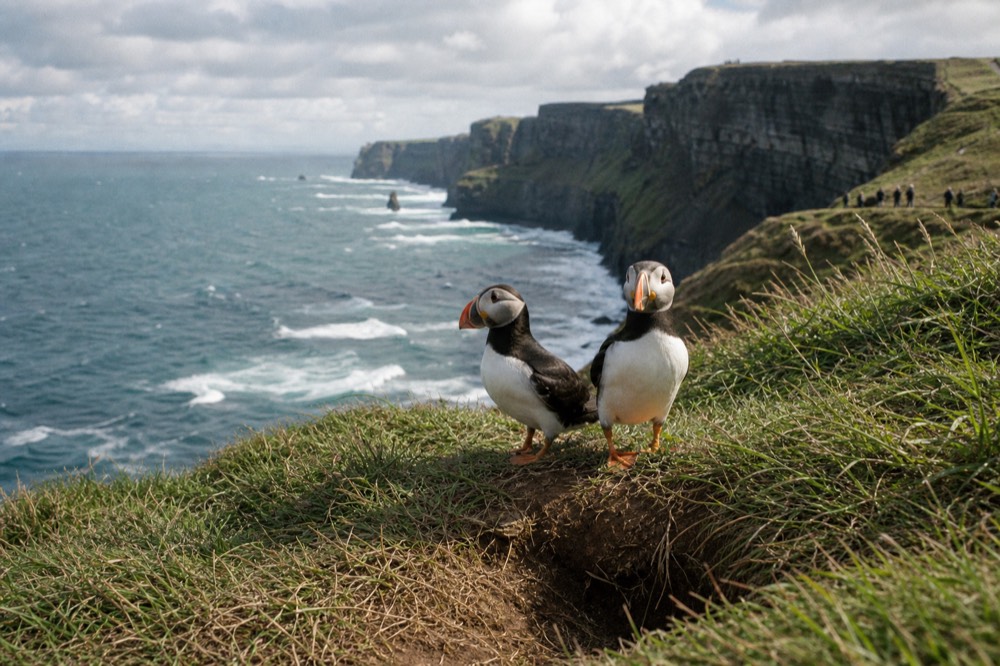
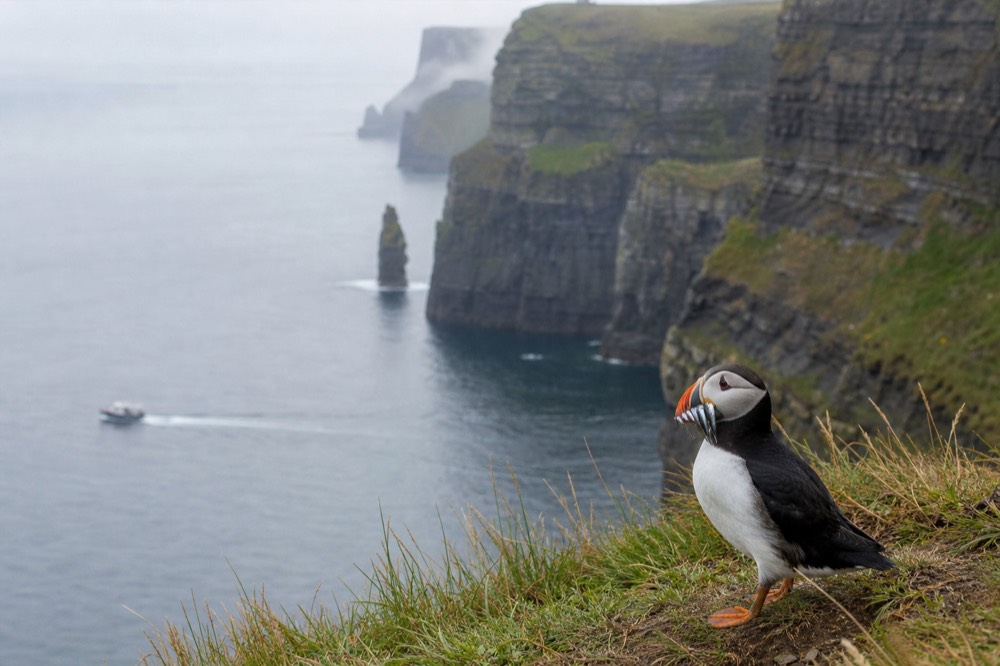
Atlantic puffins are at the Cliffs of Moher from the end of March to about mid-July, with May and June the best months by a clear margin. They nest in burrows on the grassy slopes, notably on Goat Island near the sea stack below O'Brien's Tower. Come before late March or after mid-July and the puffins have gone; the other seabirds stay on the ledges much longer.
The puffin window is narrow and non-negotiable, because the birds only come ashore to breed. They spend most of the year far out on the open Atlantic and return to land for a few months to lay a single egg and raise a chick in a burrow, according to the official Cliffs of Moher visitor site. That is the whole reason the timing matters so much: outside the breeding months there is simply nothing to see, however good the weather or the boat.
Within the window, May and June are the peak. By then the adults are settled at the colony, coming and going with beakfuls of sand eels, and the sea is often calmer than in the shoulder months, which makes for a steadier boat and clearer views. Late March and early April are hit and miss as the birds arrive, and by mid-July the colony thins fast as chicks fledge and adults head back to sea. Booking a morning in May or June is the single best move for puffins. The puffins are also the feature most likely to win over younger passengers, and our guide to bringing kids on a cliffs cruise covers what to expect with children aboard.
This site, Cliffs of Moher Cruises, is an independent comparison guide rather than a boat operator or a wildlife tour. We line up the real cruises that pass the seabird colonies and route you to the operator's own page to book. Our job here is to be straight about the timing, so you do not pay for a July trip expecting puffins that have already left.
What is the seabird calendar, month by month?
Puffins hold the ledges from late March to mid-July, peaking in May and June. Guillemots, razorbills and kittiwakes breed from spring through mid or late summer. Fulmars and shags are present across most of the year. The best overall seabird cruising runs from April to July, when the colony is fullest and loudest. Outside summer, expect fulmars and gulls but no puffins.
Thinking in months rather than seasons is the way to plan a bird-focused cruise, because the species overlap but do not share the same calendar. The scorecard below is a planning allowance, not an operator promise; birds are wild and a cold spring or an early fledging shifts the edges by a week or two. It is drawn from the official cliffs guidance and the National Parks and Wildlife Service records for the colony.
| Month | Puffins | Other seabirds on the ledges | Marine life odds |
|---|---|---|---|
| February to March | Arriving from late March | Fulmars settling, early guillemots | Low, occasional seals |
| April | Present, building up | Guillemots, razorbills, kittiwakes arriving | Low to moderate |
| May | Peak, very active | Full colony, all species breeding | Moderate, calmer seas help |
| June | Peak, very active | Full colony, chicks appearing | Moderate |
| July | Thinning from mid-month | Guillemots and razorbills fledging | Moderate, warmest water |
| August to September | Gone | Fulmars, gulls, late stragglers | Moderate for dolphins |
| October to early November | None | Fulmars, gulls, shags | Low, weather-dependent |
Read across the rows and the message is simple. If puffins are your goal, the trip has to fall between April and mid-July, ideally May or June. If you want the fullest, loudest colony of all species, the same window delivers it. If you are cruising in spring's edges or in autumn, come for the cliffs and the fulmars and treat any puffin as a bonus rather than the plan. Our guide to the calmest months to sail lines this up against the weather, and the blog on the best month to visit the cliffs weighs birds against crowds and light.
Which seabirds will you see besides puffins?
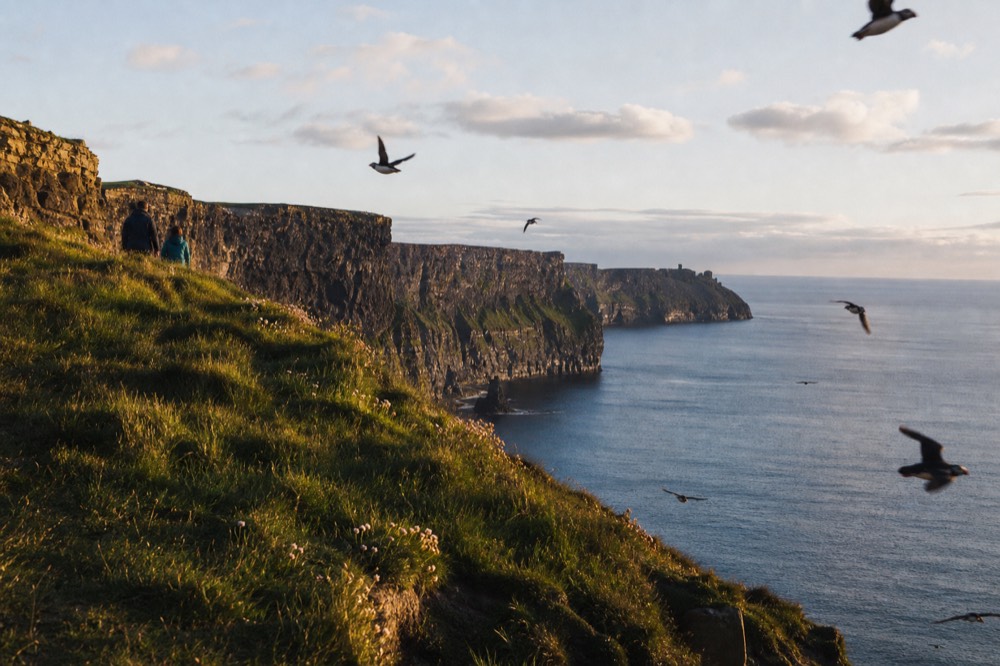
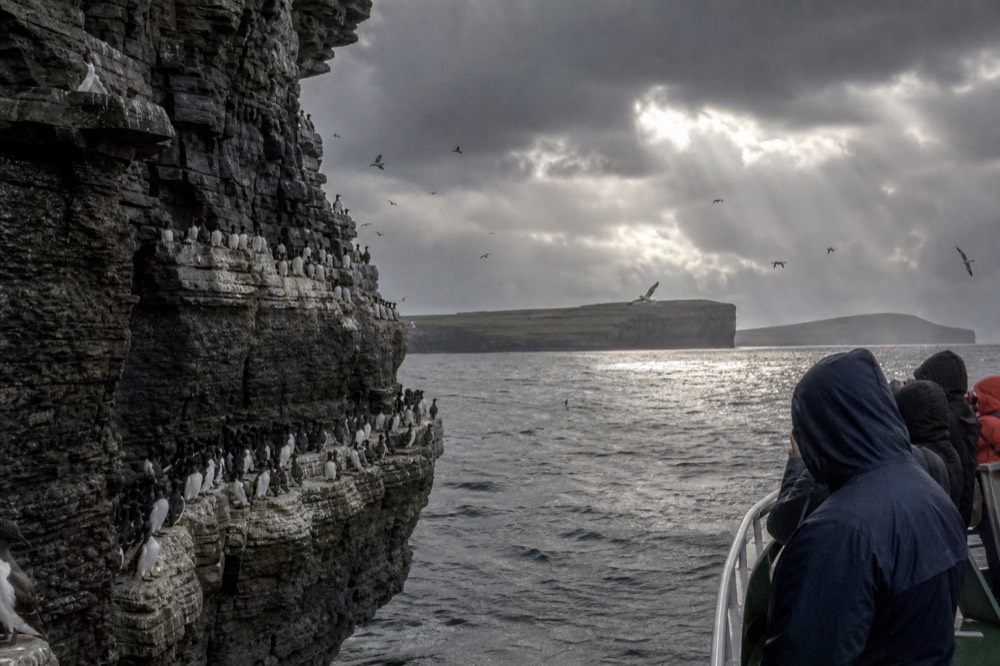
Even without puffins, the cliffs hold one of Ireland's major seabird colonies, over 30,000 pairs in season. From the boat you will see common guillemots and razorbills packed on the ledges, black-legged kittiwakes nesting on the rock, northern fulmars gliding stiff-winged along the face, and European shags near the waterline. Peregrine falcons, choughs and ravens patrol the cliffs above.
The puffins get the postcards, but they are a minority of the birds you will actually see. The dense masses on the ledges are guillemots and razorbills, and the constant gliding traffic along the cliff face is mostly fulmars. Learning to tell a few apart turns a wall of birds into a colony you can read, and the crew's commentary usually points out the main players as the boat passes them.
| Species | When present | Where to look | Quick ID |
|---|---|---|---|
| Atlantic puffin | Late March to mid-July | Grassy slopes, Goat Island | Small, black and white, bright orange beak |
| Common guillemot | Spring to late summer | Packed upright on open ledges | Dark brown, slender, penguin-like stance |
| Razorbill | Spring to late summer | On ledges among guillemots | Black, thicker blunt bill with a white line |
| Black-legged kittiwake | Spring to summer | Nesting on small rock ledges | Small gull, black wingtips, gentle call |
| Northern fulmar | Most of the year | Gliding along the cliff face | Stout grey and white, stiff-winged glide |
| European shag | Most of the year | On rocks near the waterline | Dark, snake-necked, low over the water |
The species that catches most first-timers off guard is the guillemot, because there are so many of them, standing shoulder to shoulder on the open ledges in dark, upright ranks. Razorbills mix in among them, a little blacker and blunter in the bill. Kittiwakes, small and neat, take the smaller ledges and give the colony much of its noise. Fulmars, which look like gulls but fly on stiff, gliding wings, are the birds most likely to sweep close past the boat. For the full sea-level rundown of everything the cruise passes, our guide to what you see from the water, point by point goes feature by feature.
Where on the cruise do the birds gather?
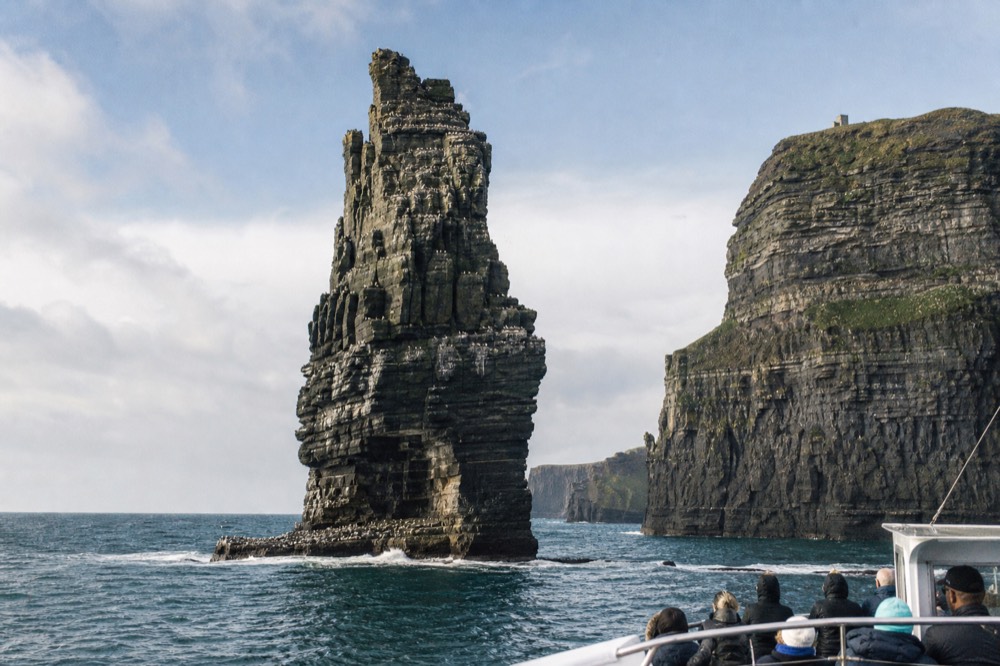
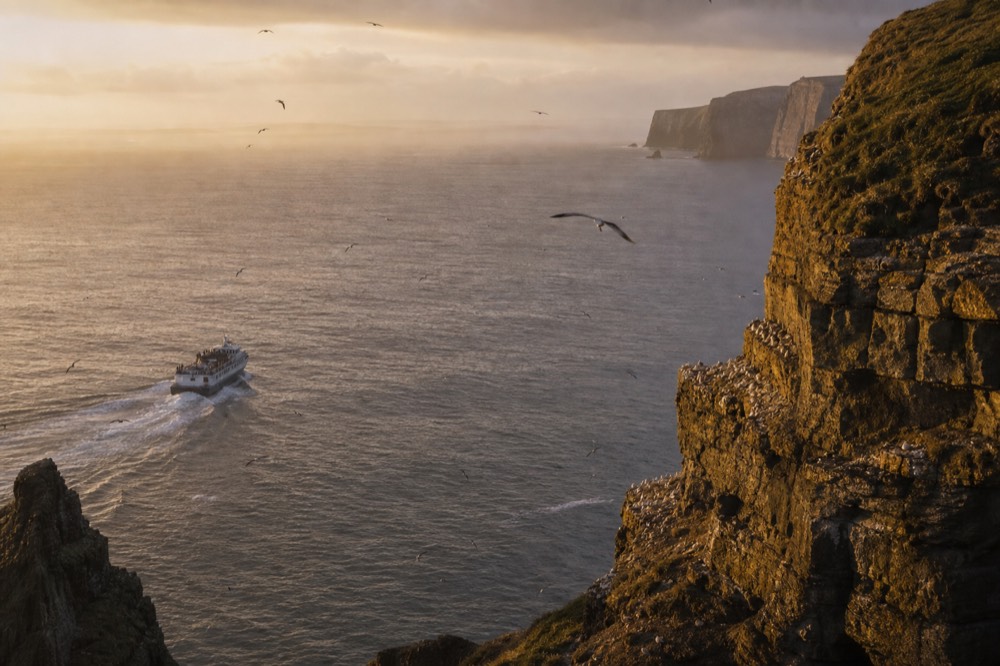
The birds concentrate at the An Branán Mór sea stack and on Goat Island, both below O'Brien's Tower, where the puffins nest on the grassy slopes. The 67-metre sea stack is described as one of the largest seabird roosts on the coast, and the crew slows the boat there on most sailings. The open ledges along the main cliff face hold the guillemots, razorbills and kittiwakes.
Knowing where to look turns a good cruise into a great one, because the birds are not spread evenly along the wall. They cluster at a few hotspots, and the boat's route is built to pass them. The single richest spot is the An Branán Mór sea stack, a free-standing pillar of rock about 67 metres high at the foot of the cliffs, cut off from the mainland by erosion and now white with nesting birds. The Burren and Cliffs of Moher Geopark records the whole coast as a major breeding site.
| Where | What gathers there | When it is best |
|---|---|---|
| An Branán Mór sea stack | Dense mixed colony, a major roost | All season, crew slows here |
| Goat Island grassy slopes | Puffin burrows | Late March to mid-July |
| Open cliff ledges | Guillemots, razorbills, kittiwakes | April to late summer |
| The cliff face in flight | Fulmars gliding, gulls | Most of the year |
| Rocks near the waterline | Shags, resting birds | Most of the year |
The practical upshot: when the boat slows at the sea stack, that is your moment. Have the camera ready and your eyes on the grassy slopes above the waterline for the puffins, and on the packed ledges for the guillemots and razorbills. The crew times the approach for viewing and photos where conditions allow, though on a rough day the boat holds further off. When you have a date in mind for the birds, you can check the current price and sailing times on the operator's own page.
What are your real chances of seeing puffins?
Good in May and June, patchy at the edges of the window, and nil outside it. Puffins are wild, so no operator guarantees them, but in peak season a calm sailing that reaches the sea stack usually delivers sightings, and the crew points them out. Bring binoculars, sit on the seaward side, and book a calm morning. On a rough day the boat holds off the stack and views are harder.
Honesty matters here more than anywhere, because puffins are the reason many people book and the birds owe you nothing. Reviews from the cruises describe puffins as likely with a bit of luck in the right months, with crews often calling them out, but also the occasional trip in the window that misses them. The odds you can improve are the ones in your control: the timing, the conditions and where you sit.
| What improves your odds | What lowers them |
|---|---|
| Sailing in May or June | Booking outside late March to mid-July |
| A calm morning with light wind | A rough day when the boat holds off the stack |
| Binoculars and a seaward seat | Relying on the naked eye at distance |
| A sailing that slows at the sea stack | Rushing past in poor conditions |
| Patience and watching the grassy slopes | Expecting puffins on every ledge like a zoo |
The single biggest lever is the calendar, followed by the weather. A flat, bright morning in late May, on a boat that eases in under the sea stack, is about as good as puffin viewing from the water gets in Ireland. A grey, blowing afternoon in April, when the boat cannot safely close the distance, is the same route with a fraction of the payoff. If the birds are your priority, treat the weather forecast as part of the booking, and keep the date flexible. Our honest look at how rough the crossing gets helps you read a sailing before you commit.
The third Doolin listing, a Doolin Ferry Co cruise of about an hour with 97 reviews on the listing, is a fine bird-watching option when its timing suits, and you can check its departure times and the live price directly. All three Doolin cruises run the same route past the same colonies, so pick on timing and price rather than expecting one to out-bird another.
What about dolphins, seals and whales?
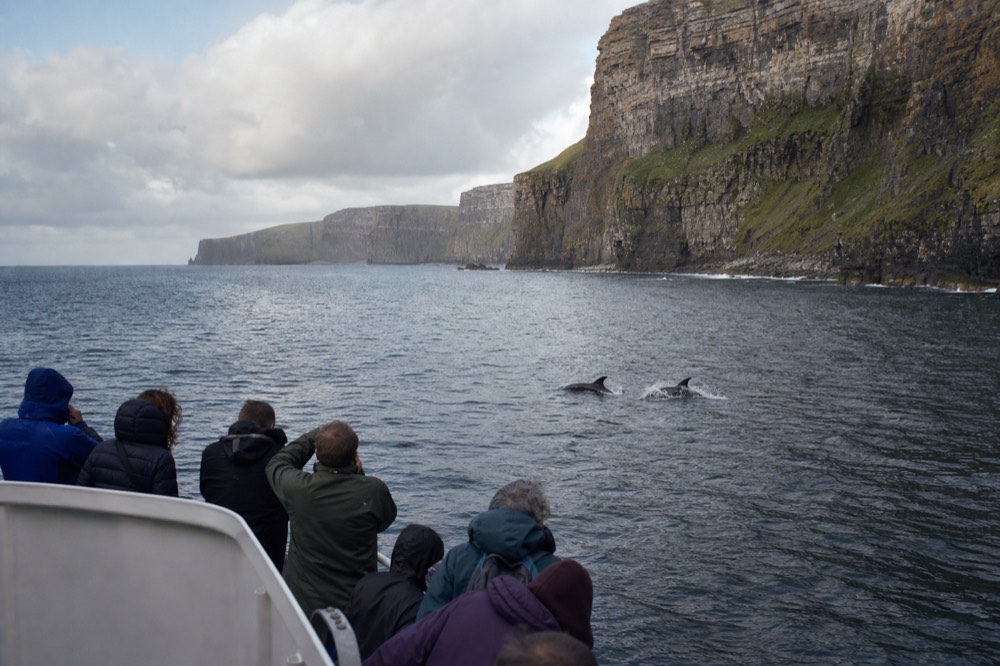
Possible, never guaranteed. The operators list bottlenose and common dolphins, grey seals, and on rare days a basking shark or minke whale as possible sightings on any cruise, framed honestly as luck rather than a fixture of the trip. Dolphins are the most likely of the group, more so in summer. Treat any marine sighting as a bonus on top of the cliffs and the birds, not a reason to book.
Marine life is the part of the listing that quietly sets up disappointment if you read it wrong. The descriptions mention dolphins, seals and whales because they do genuinely turn up, but they are wild animals in open water, and plenty of cruises see none of them. The one you are most likely to meet is a dolphin, and a pod crossing the bow is a real highlight when it happens.
| Marine animal | Likelihood on a cruise | When most likely |
|---|---|---|
| Common or bottlenose dolphin | Possible, the best bet | Late spring through summer |
| Grey seal | Possible, near rocks | All season |
| Basking shark | Rare | Warmer summer months |
| Minke whale | Rare | Summer, calm conditions |
A note for context rather than the cruise itself: north Clare saw several dolphin strandings near Ballyvaughan over the winter of 2025 into 2026, which drew the Irish Whale and Dolphin Group and the wildlife service. Those were strandings on the shore, not live sightings from a boat, and they are not a sign of what you will or will not see on a summer cruise. The honest planning line stays the same: come for the cliffs and the seabirds, and let the dolphins be a gift if they appear.
If you want more time on the water for a better chance at both birds and marine life, a longer trip that pairs the cliff cruise with an Inis Oírr landing keeps you out longer, and you can check the sailing times and the live price for that combination. Our guide to pairing the cliffs with an Aran island covers those longer options.
Which cruise is best for seabirds and puffins?
The Doolin Ferry Company cruise is the best all-round bird-watching pick: 45 to 60 minutes right under the wall past the sea stack and colonies, rated 4.4 across 844 reviews from about €30. All three Doolin cruises run the same colony-passing route. The Galway ferry that only passes the cliffs briefly is the weakest for birds. Book a calm May or June morning for the best of it.
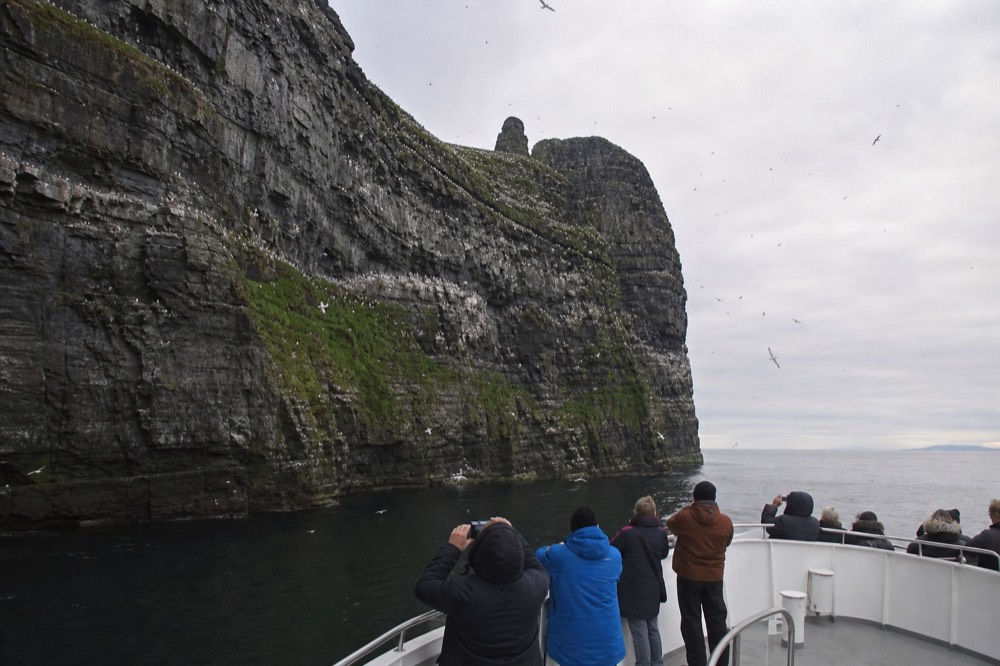
For seabirds, the deciding factor is time under the cliffs, and the dedicated Doolin cruises win it. They spend the whole sailing along the base of the wall, slow at the sea stack where the birds are thickest, and give you the closest, longest look at the colony from sea level. The combinations that add an island keep you out longer overall, which can help with marine life, but the pure Doolin cruise is the most concentrated dose of birds for the money.
| For birds you want | Book | Why |
|---|---|---|
| The most concentrated colony viewing | Doolin Ferry Company cruise | Full run under the wall, slows at the sea stack |
| The same route if the first is sold out | Another Doolin Pier cruise | Same colonies, same water, different listing |
| Longer on the water for birds and dolphins | A Doolin Inis Oírr combination | More time out, plus an island landing |
| The least bird time | The Galway City Aran ferry | Only a brief cliff pass on the return |
The move that matters more than the listing is the slot. A calm May or June morning on any of the dedicated Doolin cruises will beat a rough autumn afternoon on the fanciest option every time, because the birds and the boat both behave better in settled conditions. Pick the window first, the weather second, and the exact listing last. Our master ranking of the nine cruises worth booking and the three Doolin cliff cruises compared both help you choose.
So when should you book for the birds?
Book a calm morning in May or June for the fullest colony and the best puffin odds, the peak of a window that runs from late March to mid-July. Any time from April to July gives strong seabird viewing on a dedicated Doolin cruise. Outside that, come for the cliffs and the fulmars, not the puffins. Keep the date flexible for weather, and treat dolphins as a bonus.
The whole guide comes down to one booking rule: get the month right first. A puffin cruise is only a puffin cruise between late March and mid-July, and it is at its best in the two months of May and June, when the colony is full, the birds are active, and the sea is often calm enough for a steady, close approach to the sea stack. Get that window right and the rest, the exact listing, the price, follows easily.
If your trip falls outside the puffin months, the cruise is still worth it for the cliffs, the sea stack and the guillemots, fulmars and kittiwakes that hold the ledges far longer than the puffins do. Just book with the right expectation. For the calmest conditions in the puffin window, our guide to the weather at the cliffs in May is a useful companion, and the operator's own Doolin Ferry timetable is the primary source for the 2026 sailings and their times.
Frequently asked questions
When is the best time to see puffins at the Cliffs of Moher?
May and June are the best months, within a window that runs from the end of March to about mid-July. The birds come ashore only to breed, nesting in burrows on the grassy slopes and on Goat Island near the sea stack. Outside that window there are no puffins, though guillemots, razorbills, kittiwakes and fulmars stay on the ledges for much longer.
Will I definitely see puffins on the cruise?
No cruise can guarantee them, because puffins are wild birds. In May and June, on a calm sailing that reaches the sea stack, sightings are likely and the crew usually points them out. Your odds improve with the right month, calm conditions, a seaward seat and binoculars. Outside late March to mid-July, the puffins have gone and you will not see them at all.
What other birds will I see besides puffins?
Plenty. The cliffs hold one of Ireland's major seabird colonies, over 30,000 pairs in season. From the boat you will see common guillemots and razorbills packed on the ledges, black-legged kittiwakes nesting on the rock, northern fulmars gliding along the face, and European shags near the waterline. Peregrine falcons, choughs and ravens patrol the cliffs above the colony.
Can you see dolphins or whales on the cruise?
Sometimes, but never as a guarantee. Operators list common and bottlenose dolphins, grey seals, and on rare days a basking shark or minke whale as possible sightings. Dolphins are the most likely, especially in summer. Treat any marine sighting as a bonus on top of the cliffs and the seabirds, rather than a reason to book, and keep your expectations on the birds and the rock.
Which cruise is best for seeing seabirds?
A dedicated Doolin cruise is best, because it spends the whole sailing under the cliff wall and slows at the An Branán Mór sea stack where the birds are thickest. The most reviewed is the Doolin Ferry Company cruise, 4.4 across 844 reviews from about €30. Ferries from Galway that only pass the cliffs briefly on the return give far less time in front of the colony.